More than 140 supported networks can make a wallet look powerful, but network count is not the most important measure of safety. The counterintuitive point is that a DeFi wallet is valuable less because it stores tokens than because it helps a user interpret what a smart-contract interaction is about to do. For users in Germany moving between Ethereum, Layer 2 networks, sidechains and newer EVM-compatible ecosystems, the central problem is not simply access. It is avoiding a costly misunderstanding at the moment of signing.
That distinction places Rabby in a different category from a basic account interface. It is a non-custodial wallet designed around DeFi activity, with transaction simulation, contract warnings, automatic network selection and support for hardware wallets. These features do not eliminate protocol risk, bridge risk or user error. They can, however, change the decision process from “approve and hope” to “inspect, simulate and then approve”. That is a meaningful improvement in operational discipline.
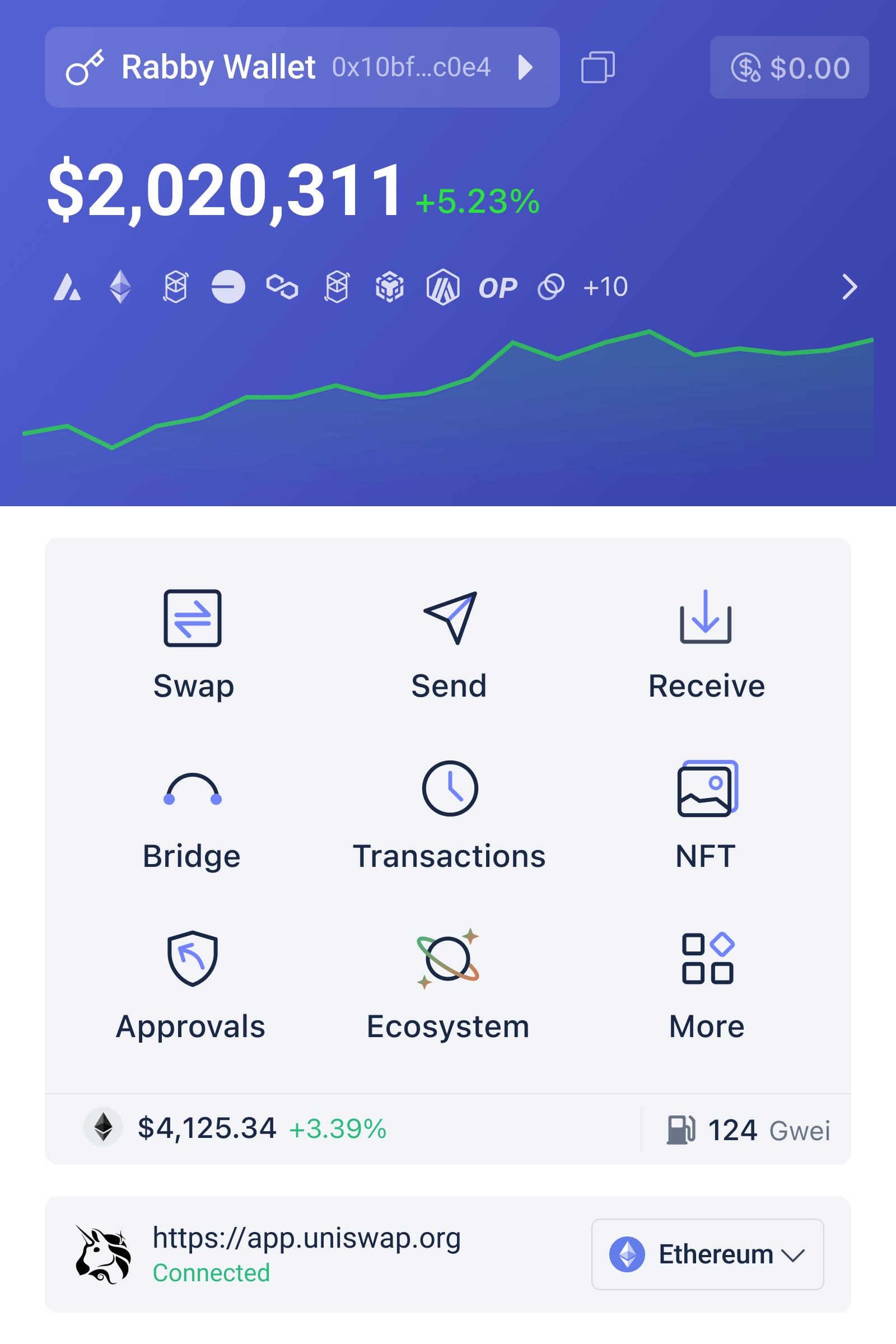
From token storage to transaction interpretation
A common misconception is that a wallet itself performs a DeFi transaction. In most cases, the decentralised application creates a transaction request, the wallet displays it, and the user signs it with a private key. The wallet is therefore an interface and a signing environment, not normally the economic actor executing the contract logic. Rabby’s stated role as an independent checker is important in this context: it does not create or alter the transaction merely to produce a more convenient result.
Before a signature is made, Rabby can simulate the proposed interaction and show expected changes to token balances. Mechanically, this gives the user a preview of the contract call’s likely consequences: assets leaving an account, assets arriving, approvals being changed, or a position being modified. The practical insight is that simulation converts opaque hexadecimal transaction data into a more intelligible balance-sheet question: what do I expect to own after this operation, and does the result match the action I intended?
This is especially useful for approvals. An approval does not always transfer tokens immediately; it can grant a contract permission to move tokens later. An “infinite approval” may be convenient because it avoids repeated permission transactions, but it also enlarges the potential loss if the approved contract is compromised or the user interacts with a malicious address. A warning about such an approval is not proof that the protocol is fraudulent. It is a prompt to distinguish convenience from exposure.
Simulation also has a boundary that users should understand. It is a prediction of how a transaction is expected to behave under a particular state of the blockchain and a particular set of assumptions. State can change between simulation and inclusion. Prices may move, liquidity may disappear, a contract may depend on external data, or the transaction may be routed through several protocols. A successful simulation is evidence about expected execution, not an insurance policy and not a formal proof that the underlying protocol is safe.
Why multi-chain convenience can improve safety—and create new risks
Rabby supports a broad range of EVM-compatible chains, including Ethereum, Polygon, Arbitrum, Optimism, Avalanche, Base and BNB Chain. EVM compatibility means that these networks share important technical conventions, allowing similar wallet accounts and contract interaction patterns. For an active DeFi user, this reduces the friction of maintaining separate interfaces and repeatedly configuring networks by hand.
Automatic network switching is a good example of a feature with a two-sided effect. When a decentralised application requests a specific network, the wallet can recognise the requirement and switch accordingly. This reduces accidental attempts to use the wrong chain and makes routine activity faster. Yet speed can also weaken attention. A user who no longer notices the network indicator may sign an economically significant transaction without appreciating that the asset, liquidity or security assumptions differ from those on Ethereum mainnet.
The more useful mental model is not “one wallet, many chains”, but “one signing authority, many security domains”. Each network has its own validators or sequencer arrangements, fee market, bridge connections, contract deployments and failure modes. A token with the same symbol on two chains may not represent the same redemption or liquidity conditions. Multi-chain access simplifies the interface; it does not unify the underlying risks.
Integrated bridging illustrates the same trade-off. Protocols such as LI.FI can help route assets across networks from within the wallet interface. This is convenient for someone who wants to move funds between, for example, Ethereum and a Layer 2 without opening several applications. But a bridge is not merely a transfer button. It introduces an additional trust and execution layer, and in some routes may combine bridges, decentralised exchanges and settlement steps. The interface may be unified while the risk remains composable and route-specific.
Security architecture: useful separation, not a guarantee
Rabby stores private keys locally under a non-custodial model rather than sending them to Rabby’s servers. This changes the custody relationship: the user controls the signing authority, while the provider supplies software and supporting services. The benefit is reduced dependence on a central custodian for access to funds. The cost is that responsibility for backups, device security, malware resistance and recovery procedures remains with the user.
Backend independence adds another layer of resilience. According to the project’s design, core signing functions can remain usable even if Rabby’s servers are unavailable, because Rabby does not need to take custody of the private key or manufacture the transaction on the user’s behalf. This is valuable during service interruptions. It should not be confused with complete independence from infrastructure: blockchain access, fee estimation, transaction broadcasting, security data and some interface features can still depend on external services or network availability.
The open-source architecture, released under the MIT licence, makes independent review possible and is a constructive transparency signal. It does not mean that every user has personally audited the code, nor that every integrated third-party protocol has identical transparency. Open source improves the conditions for scrutiny; it does not automatically convert scrutiny into certainty. A careful user should still separate the wallet’s code, the dApp’s code, the bridge route and the hardware or operating system used for signing.
Hardware-wallet compatibility with Ledger, Trezor and OneKey is therefore more than a premium feature. It establishes a separation between the computer displaying the transaction and the device holding the signing key. This can reduce the impact of some malware scenarios, although the user still has to verify what is shown and approve on the correct device. A hardware wallet protects keys particularly well; it cannot make a malicious transaction economically harmless if the user confirms it.
Gas, swaps and the economics of convenience
Rabby’s integrated swap aggregator can compare routes across decentralised exchanges such as Uniswap and 1inch, with the objective of improving price execution and limiting slippage. Slippage is the difference between the expected and final exchange price, often caused by changing market conditions or insufficient liquidity. Aggregation can therefore be useful, but “best rate” is not a permanent property. The result depends on route availability, fees, liquidity, price impact and the time between quotation and execution.
The Gas Account feature addresses a familiar multi-chain problem: a user may hold USDC but lack the native token required to pay transaction fees on the target network. Paying gas with supported stablecoins can reduce the need to maintain small balances of several native assets. For users managing portfolios across many EVM networks, this is a real usability gain. It also introduces an additional service and conversion mechanism, so users should examine the applicable exchange rate, fee structure and network support before treating it as frictionless.
Rabby Points, earned through activities such as swaps, gas top-ups or referrals, belong to a different category. Loyalty systems may encourage engagement, but points are not automatically equivalent to money, governance rights or a guaranteed future benefit. The rational approach is to treat them as a secondary interface incentive rather than a reason to increase trading frequency. This matters because reward design can subtly turn useful wallet activity into unnecessary transaction activity, with gas costs and smart-contract exposure attached.
A practical decision framework for DeFi users in Germany
For someone evaluating the rabby wallet extension, the most useful question is not whether it is “the safest wallet”. No software can answer that honestly in isolation. Ask instead which part of the transaction workflow it improves and which risks remain outside its control. A sensible review has four stages.
First, verify the context: correct website, correct account, correct network and correct asset. Second, inspect the transaction: distinguish a transfer, a swap, a contract approval, a bridge action and a signature that does not directly move tokens. Third, compare the simulation with the intended outcome, paying attention to approvals, unexpected assets and unusually broad permissions. Fourth, use a hardware wallet for material holdings and maintain a separate, limited-value account for experimentation.
This framework is particularly relevant when a German user moves between long-term holdings and active DeFi positions. Tax reporting, portfolio records and fee accounting become harder when transactions span several chains and include bridges or swaps. A wallet cannot determine the user’s tax treatment, but clearer transaction histories and more explicit network context can make later reconciliation less error-prone. That is an administrative benefit, not a legal conclusion, and users should obtain professional advice where their individual circumstances require it.
The strongest case for Rabby is consequently narrower—and more credible—than a general claim of superiority. It is well aligned with a workflow in which users interact with many EVM dApps and need more information before signing. Automatic network selection, simulation, risk warnings and hardware support address different points in the same problem: reducing the gap between what the user thinks will happen and what the contract call may actually do.
What to watch as wallets become more intelligent
The recent positioning of Rabby around Ethereum and EVM use reflects a broader direction in wallet design: interfaces are becoming interpretation layers rather than passive key managers. If simulation and security warnings become more accurate and easier to audit, users may rely less on raw contract data and more on structured explanations. That could improve safety for ordinary interactions, provided the explanations remain transparent and do not encourage blind acceptance.
The unresolved issue is accountability. When a simulation misses a contract exploit, or a warning fails to identify a malicious route, responsibility is difficult to allocate among the wallet, the dApp, the bridge and the user. This is why advanced wallet features should be viewed as decision support. They can improve the quality of a decision, but they cannot replace independent verification for unfamiliar protocols or high-value transactions.
Frequently Asked Questions
Does transaction simulation guarantee that a DeFi transaction is safe?
No. Simulation shows expected effects under current assumptions, such as anticipated token balance changes. It may not capture future state changes, economic manipulation, governance risk, compromised interfaces or every behaviour of an external protocol. Treat it as a powerful review aid, not a guarantee.
Is Rabby suitable for users who operate on several EVM chains?
It is designed for that use case and supports more than 140 EVM-compatible networks, with automatic network switching and tools for swaps and bridging. The convenience does not remove chain-specific risk. Users should still confirm the network, asset representation, fees and bridge route before signing.
Are private keys protected if Rabby’s servers are unavailable?
The non-custodial design stores private keys locally, and core signing functions are intended to remain usable during Rabby service interruptions. However, broadcasting transactions, retrieving network data or using certain supporting features may still depend on external connectivity and infrastructure.
Should a hardware wallet still be used with Rabby?
For significant holdings, hardware signing adds an important layer of protection because the private key remains on a separate device. It does not remove the need to inspect the transaction. A secure key can still authorise an unwanted approval, swap or bridge if the user confirms the wrong action.